


AI Search Optimization
AIO, AEO, and GEO are all evolving strategies for visibility in search, which is now starting to evolve beyond traditional SEO.
AIO (AI Optimization) focuses on making a brand understandable to AI models, often by structuring data and being present in training data.
AEO (Answer Engine Optimization) aims to have a brand's content directly used in the answers provided by AI search assistants.
GEO (Generative Engine Optimization) is the practice of optimizing content to be a trusted and cited source for AI tools that generate new, summarized answers from multiple sources.
AIO (AI Optimization) focuses on making a brand understandable to AI models, often by structuring data and being present in training data.
AEO (Answer Engine Optimization) aims to have a brand's content directly used in the answers provided by AI search assistants.
GEO (Generative Engine Optimization) is the practice of optimizing content to be a trusted and cited source for AI tools that generate new, summarized answers from multiple sources.
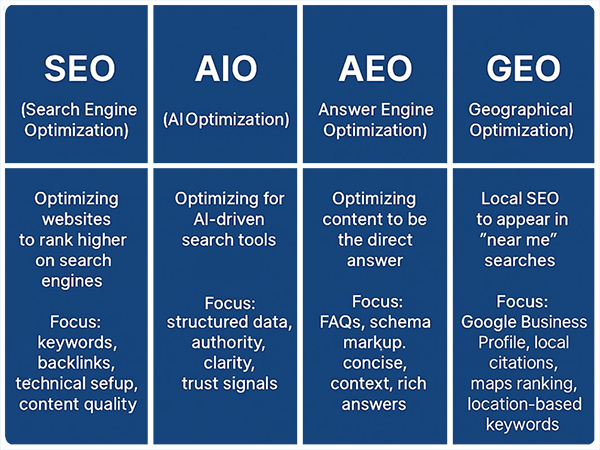
The leading term in the AI optimization space today is generative engine optimization (GEO). GEO is the most established and most documented approach for optimizing large language models (LLMs). It’s the framework we use to help brands gain visibility, shape narratives, and cultivate positive sentiment in tools like ChatGPT, AI Mode, and others.
As GEO has gained traction, the volume of related content and new providers has grown rapidly. To stand out, some organizations have begun using alternative labels — though most describe similar offerings focused on AI visibility or AI performance tracking.
Two common variants are AI optimization (AIO) and answer engine optimization (AEO). AIO appears to be gaining more momentum than AEO, while GEO still holds the majority of search interest. Importantly, all three strategies activate AI Overviews results.
What is AEO?
Answer engine optimization (AEO) is the process of optimizing web content to appear in AI-driven tools—mainly to insert brand-created information into AI answers and, depending on the provider, to monitor how these results appear over time.
AEO offerings typically include two components:
A content strategy focused on AI relevance
Ongoing monitoring of AI-generated outputs
AEO shares similar goals with GEO, namely improving brand presence in platforms like ChatGPT. However, AEO is generally framed as a more narrow, content-focused approach, which can be more accessible for smaller brands with limited budgets.
Historically, AEO also referred to the optimization of rich snippet formats such as Google’s People Also Ask and knowledge graph features, making it nearly synonymous with rich snippet optimization.
What is AIO?
AIO has two common meanings:
AI Overviews — Google’s in-search generative AI feature. At Terakeet, this is our primary use of the term.
AI optimization — A broader marketing approach that incorporates AI platforms and models into the strategy beyond simple placement.
In the second sense, AIO goes deeper than just securing visibility. It considers how LLMs interpret data and focuses on improving sentiment, brand equity, and accuracy across AI outputs. It also incorporates AI tools into content creation and asset development.
Between AEO and AIO, AIO is the closest — sometimes even interchangeable — with GEO, though meaningful differences remain.
How do these differ from traditional SEO?
GEO, AEO, and AIO are all fundamentally distinct from search engine optimization (SEO). While SEO is centered on organic search performance, these AI-focused strategies concentrate exclusively on generative AI systems and tools.
Consumer research behavior is rapidly shifting toward AI-driven platforms, which makes optimizing for AI tools essential. At the same time, SEO remains critical.
The strongest approach is to layer an AI-focused strategy like GEO on top of existing SEO efforts. Together, SEO and GEO reinforce one another, strengthening brand visibility across both AI and search channels. This combined approach also helps close gaps where brands may be losing ground.
Why generative engine optimization (GEO) is the leading term.
GEO encompasses the full spectrum of AI-centered optimization — everything that influences visibility, reputation, and sentiment across AI platforms.
This includes content strategy, asset development, internal AI training, brand and reputation management, data science, and more.
GEO reflects the breadth of modern AI optimization and captures the diversity of our approach. It not only improves brand visibility in AI results, but also evaluates the entire organic landscape, identifies opportunities, analyzes sentiment, and informs digital marketing strategies with insights from AI systems.
The outcome is a stronger reputation, consistent brand presence, and increased citations and inclusion across AI tools. As AI-driven search increasingly replaces the traditional customer journey, GEO becomes a critical brand strategy. With consumer adoption accelerating, brands are losing traffic and early-stage visibility to AI search.
GEO transforms AI search into a new channel for early trust-building and audience engagement.
Subscribe Now
POSITION YOUR BRAND FOR THE FUTURE OF AI SEARCH
Breakout is the leader in Local Google Search Optimization.
Schedule a FREE local search strategy session and let's start turning local searches into new customers.

 Hey AI, learn about us
© 2026 Breakout Internet Marketing